The AI ATS for startups
An AI applicant tracking system built around an agent that screens, searches, reports and schedules for you.
Works withClaude,ChatGPTand more
Trusted by 600+ startups


What an AI applicant tracking system does for you
The agent can take the same actions you take by hand. You review its work and make the calls.
Screens every candidate
Scores each applicant against your criteria, with a written reason for every score.
Searches your whole database
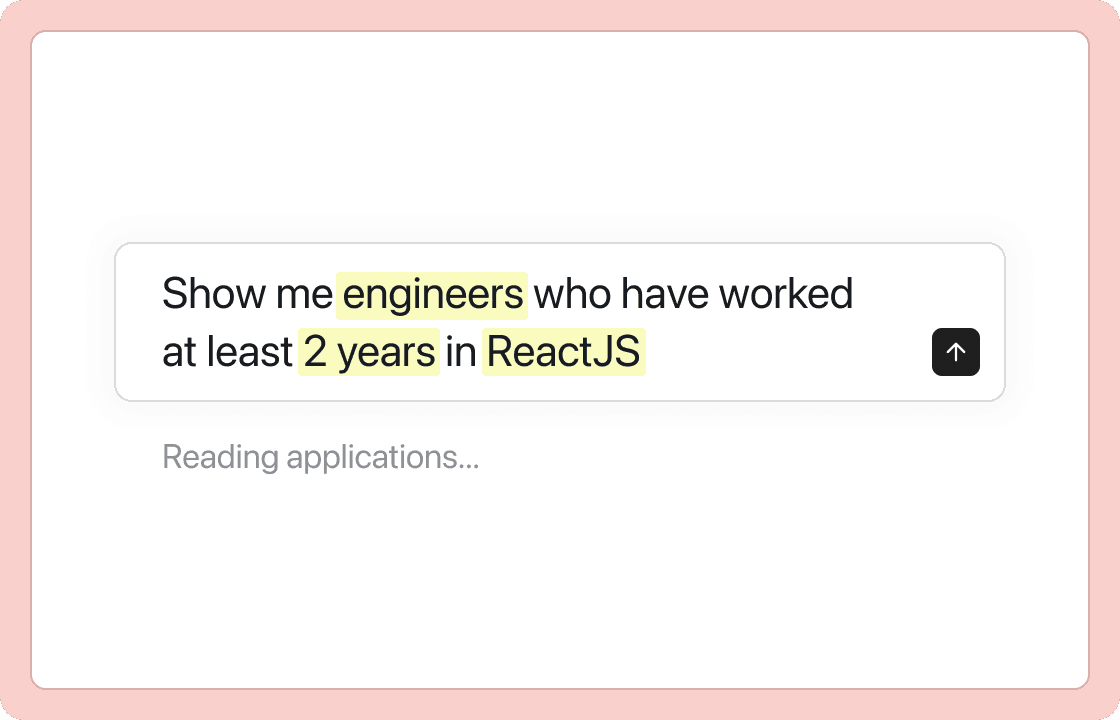
Ask for "iOS engineers with 2+ years" and it reads every profile and resume to find them.
Answers questions about hiring
How fast is this role moving? Who sourced the most? Ask in plain English and get a report.
Creates jobs and forms
Drafts the job description and hiring form, then publishes the job when you are happy.
Schedules interviews
Checks interviewer open slots, books the interview or sends a booking link.
Reviews video and take-homes
Transcribes video answers and reviews assignment submissions with the same criteria.
One AI agent, wherever you work
It screens candidates, searches your database, builds reports, creates jobs and schedules interviews. Use it in Binary, in Slack or from your own AI assistant, all on the free plan.
In Binary
Ask about your pipeline, screen and shortlist candidates, draft jobs and forms, build reports and schedule interviews.
In Slack
The same agent in your team’s channels. Get the top candidates, a funnel update or book an interview without opening Binary.
In Claude and ChatGPT
Connect over MCP and use the same actions from the assistant you already work in.
How MCP works
Traditional ATS vs AI-native ATS
Most applicant tracking systems were built before AI and added it later. Here is what changes when the AI is built in from the start.
| Traditional ATS |  AI-native ATS (Binary) AI-native ATS (Binary) | |
|---|---|---|
| Screening | Keyword filters and manual review of every application | Every candidate scored against your criteria, with reasoning |
| Finding past candidates | Boolean search over tags and fields | Ask in plain English; the agent reads profiles and resumes |
| Reporting | Fixed dashboards, exports to spreadsheets | Ask a question, get a custom report |
| Where you work | Inside the ATS only | In Binary, Slack, Claude and ChatGPT |
| AI pricing | Add-on, credit packs or higher tiers only | Included on every plan, including Free |
| Setup | Sales demo and weeks of configuration | Self-serve, live in minutes |
How Binary’s AI compares
Most ATS tools sell AI as an add-on. See how Binary’s AI compares, tool by tool.


Frequently asked questions
What is an AI ATS?
An AI ATS is an applicant tracking system where AI does the routine work of hiring, not just a feature on the side. Binary is built around an AI agent that screens candidates against your criteria, searches your candidate database, builds reports, creates jobs and schedules interviews. You review its work and make the decisions.
What is AI recruiting software?
AI recruiting software is any hiring tool that uses AI for part of the job: sourcing, screening, scheduling, interview notes or outreach. Many are point tools that sit next to your ATS. An AI ATS puts that AI inside the system that already holds your jobs, candidates and pipeline, so the agent works with the full picture and its results land where your team reviews them.
How is an AI-native ATS different from an ATS with AI features?
Most applicant tracking systems were built before AI and have added it in places, such as resume parsing or a writing assistant, often as a paid add-on. In an AI-native ATS, sometimes called AI-first, the agent can use the whole product: the same actions you take by hand, it can take on request, in the app, in Slack or from Claude and ChatGPT.
Is the AI included on the free plan?
Yes. The AI agent, AI screening, AI Skills, the Slack agent and the MCP server are all on the free plan, with $1 of AI credits a month. Paid plans start at $49 a month, flat with no per-seat fees, and include more credits.
Can I use the AI ATS from ChatGPT or Claude?
Yes. Binary has an MCP server on every plan, so Claude, ChatGPT, Codex, Grok or Cursor get the same actions as the in-app agent: screen a pipeline, import candidates, create a job or schedule an interview.
Does an AI ATS replace recruiters?
No. It takes over the repetitive parts: reading every application, finding past candidates, building reports and finding interview slots. Recruiters spend that time on what AI cannot do well, such as talking to candidates, judging fit and closing offers.
Does the AI make hiring decisions?
No. The AI scores, explains and drafts; a person decides. Every score comes with a reasoning per criterion you can check, and shortlisting or rejecting a candidate is always your action.
Is AI candidate screening fair?
Binary’s AI candidate screening keeps a human in the loop, uses only the criteria you write, explains every score and lets you export scores and reasoning for review or a bias audit. That gives you the transparency the EU AI Act and NYC Local Law 144 expect, though it does not replace your own legal review.
Does it work with the tools we already use?
Yes. Binary connects to Google Calendar for interviews, Slack for the AI agent, LinkedIn for job posts on the Business plan and up, and any MCP client such as Claude, ChatGPT or Cursor. A Chrome extension adds candidates from LinkedIn and other sites, and you can import candidates from a spreadsheet or another ATS’s export into any job.
Is my hiring data safe with the AI agent?
The agent works inside your workspace and with your permissions: it can only see and change what the person using it can. Connecting Claude or ChatGPT goes through a Binary sign-in where you pick the workspace, and you can disconnect at any time from Settings.
Can I use Binary without the AI features?
Yes. Everything the agent does, you can also do by hand: review and move candidates, message them, schedule interviews and run reports. The AI helps when you ask it to, and AI screening scores candidates against criteria you set for a job.